

Try it now!
Managing your investments has never been easier!





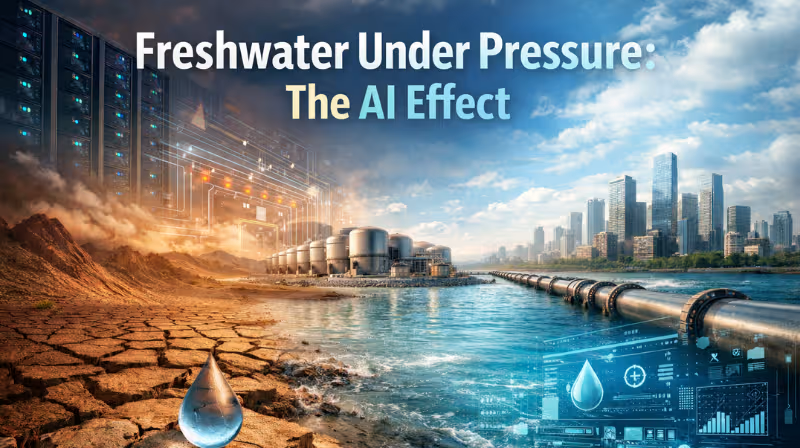

Water scarcity is emerging as one of the defining global challenges of our era, driven by surging demand and shrinking natural supplies. Simultaneously, the rapid growth of artificial intelligence (AI) data centers is spotlighting freshwater as a vital industrial resource. Together, these dynamics are transforming water from an overlooked commodity into a strategic asset class with compelling investment potential.
Freshwater has long been seen as a near-free and abundant resource, but this perception is fast changing. The United Nations projects that by 2030, global freshwater demand will exceed supply by 40% if current usage patterns persist. Population growth, urbanization, and shifting consumption habits intensify this pressure. Today, approximately 2.2 billion people lack access to safe drinking water, 3.5 billion face inadequate sanitation, and close to 4 billion experience severe water shortages for at least one month annually.
Agriculture accounts for the largest water consumption, underscoring urgency to balance withdrawals with sustainability. Since the early 1990s, over half of the world's major lakes have shrunk, threatening the health and livelihoods of a quarter of the global population relying on them. Natural wetlands have declined precipitously by 410 million hectares over 50 years—an extent comparable to the entire European Union.
These trends fuel demand for transformative technologies like desalination and long-distance water transport, turning localized scarcity into opportunities for multinational corporations and investors.
An often overlooked contributor to rising water demand is the explosive expansion of AI data centers. Training complex AI models requires vast computational power, which in turn demands extensive cooling infrastructure. These industrial cooling operations necessitate large volumes of water, making AI facilities some of the fastest-growing water consumers.
Estimates forecast AI’s water consumption could increase by 4.2 to 6.6 billion cubic meters by 2027, equivalent to the annual demand of several small nations and several times Denmark’s total water use.
Prominent data center operators like Microsoft, Google, and Amazon are investing heavily in advanced closed-loop water recirculation systems that can reduce water usage by up to 75%. Specialized technology vendors such as Xylem and Ecolab supply critical industrial cooling and water recycling equipment integral to these high-tech facilities.
Water infrastructure in developed countries, particularly in the United States, is aging and inefficient. Modernizing these systems is expected to require investments exceeding $3 trillion over the next two decades. This massive capital need creates a steady demand pipeline for engineering, construction, and technology firms.
Concurrently, the Smart Water Management (SWM) sector is booming, leveraging IoT sensors, AI analytics, and digital twin modeling to enhance monitoring and reduce water loss. Forecasts predict the SWM market will nearly double from $21.6 billion in 2024 to $43.7 billion by 2030, reflecting an annual growth rate of roughly 13%.
One key driver is the urgent need to address non-revenue water losses—water lost to leaks or inefficiencies—enabled by sophisticated digital tracking.
Regulatory shifts will further accelerate this market. From 2025 onwards, tighter U.S. EPA and European standards mandate replacement of lead water pipes and enhanced filtration to remove PFAS (“forever chemicals”), substances linked to serious health conditions. This regulatory push benefits companies specializing in membrane filtration, chemical treatment, and water quality monitoring, such as Agilent and Veralto.
For investors eager to gain exposure to this dynamic asset class, exchange-traded funds (ETFs) focused on water provide convenient and diversified entry points. Below is an overview of key water ETFs to consider:
The five water ETFs profiled above take different paths to the same scarcity thesis, from U.S.-concentrated industrial plays to globally diversified, UCITS-compliant funds.
| ETF | Focus | Top Holdings | Key Strength | Key Risk |
|---|---|---|---|---|
| PHO (Invesco Water Resources ETF) | U.S.-centric, tracks the NASDAQ OMX US Water Index | Waters Corp, Ferguson Enterprises, Ecolab, Roper Technologies, American Water Works | High liquidity and strong industrial exposure benefiting from infrastructure upgrades | Concentrated in U.S. companies, exposed to domestic policy risk; premium valuation limits upside |
| FIW (First Trust Water ETF) | U.S.-focused but equally weighted to reduce concentration risk, tracks the ISE Clean Edge Water Index | Agilent Technologies, IDEXX Laboratories, Ferguson Enterprises, Xylem | Lowest expense ratio in class (0.51%); strong water-diagnostics exposure tied to PFAS monitoring | Underweight major blue-chip names; still mostly U.S.-focused; conservative growth profile |
| CGW (Invesco S&P Global Water Index ETF) | Global diversification, tracks the S&P Global Water Index | SABESP (Brazil), Xylem, United Utilities (UK), Severn Trent (UK) | Sector balance offers growth and defensive stability; exposure to Brazilian privatization upside | Brazilian political and currency risk; UK utilities face regulatory scrutiny; smaller fund may limit liquidity |
| PIO (Invesco Global Water ETF) | Emphasizes non-U.S. global leaders listed on major exchanges | Pentair, Veolia, Ebara Corp, Ecolab | Access to European and Asian market leaders and Japan's advanced water technologies | Highest fees among the group; low liquidity; currency volatility; industrial-cycle sensitivity |
| IH2O (iShares Global Water UCITS ETF) | Largest global water fund, UCITS-compliant, tracks the S&P Global Water Index | Xylem, SABESP, American Water Works, Veolia | Largest fund size gives liquidity and narrow bid-ask spreads; tax-efficient UCITS structure | Higher fees; emerging-market and currency risk; tax complexities for U.S. investors |
As of February 2026, per each fund's stated index/strategy and holdings as described above. Fund composition, fees, and holdings change over time — verify current facts on the issuer's site before investing. Not a recommendation to buy any security. For help weighing sector ETFs like these against your overall allocation, 8FIGURES' portfolio analyzer can show how a water-sector position fits your existing diversification.
The water sector is not the stagnant, yield-only category of the past. It now encompasses a spectrum from steady, regulated utilities to high-growth innovative technology companies.
For portfolio construction, a barbell approach combining core stability with satellite growth can enhance returns and risk management:
The water sector in the mid-2020s stands at the intersection of scarcity and surging demand, driven by climate pressures and technological evolution. Water is indispensable, but conservation, recycling, and monitoring solutions are scalable and investable.
Despite limited public awareness, this trillion-dollar infrastructure upgrade opportunity is ripe for investors seeking diversified ETF exposure combining defensive reliability with compelling growth. Water investing offers a unique blend of stability and innovation, making it an essential consideration for modern portfolios.
For forward-looking strategies and tailored guidance, explore 8FIGURES, the AI investment advisor helping investors navigate complex markets with confidence.
Managing your investments has never been easier!