
Try it now!
Managing your investments has never been easier!





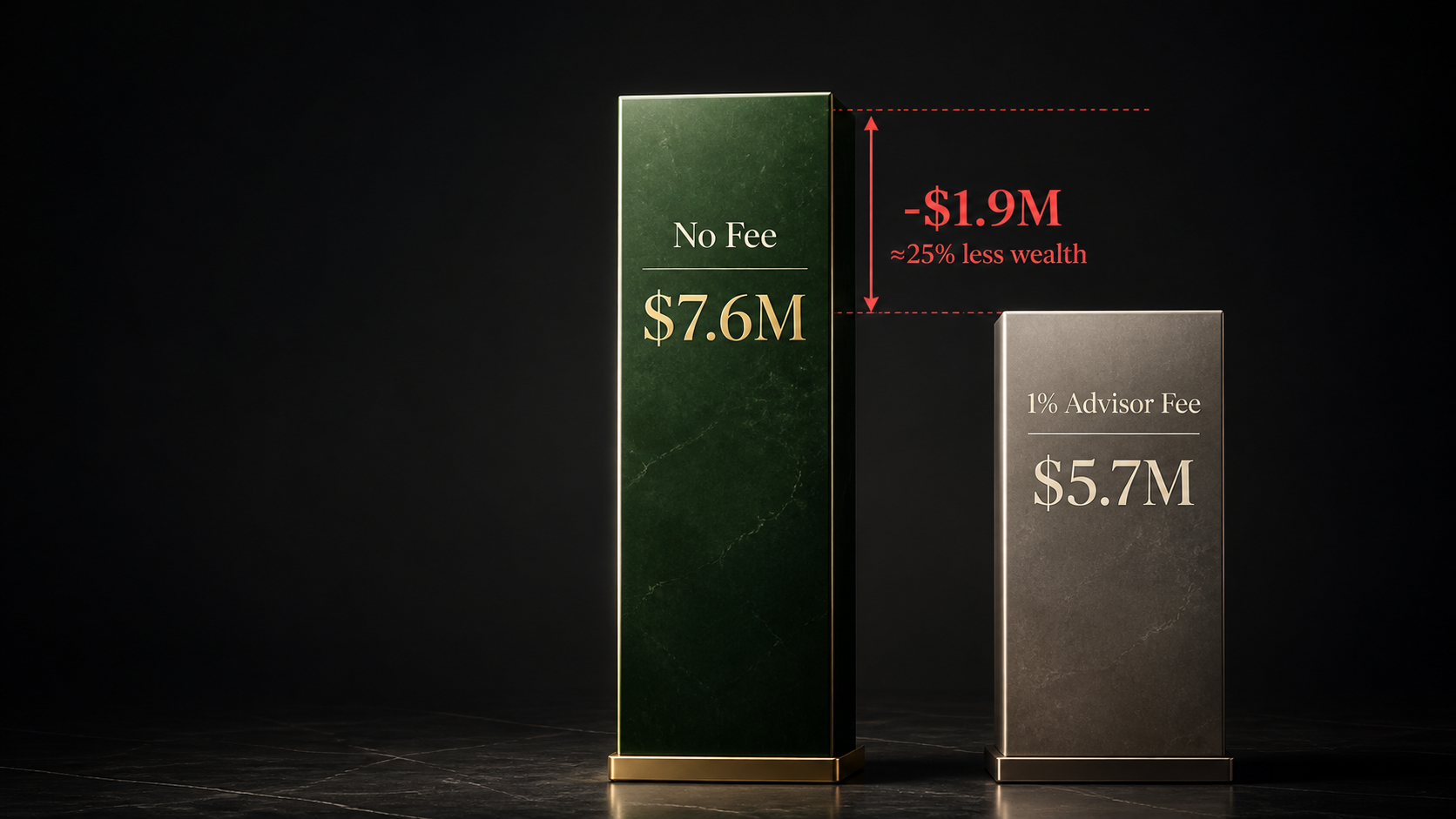

The average financial advisor still charges 1%. Compound that 1% over 30 years and you give up about a quarter of your final wealth.
That is the math the industry does not lead with. Here is what it actually looks like.
Take a $1 million portfolio. Assume a 7% gross annual return — roughly in line with the historical average for a balanced index portfolio over long periods.
Difference: $1.9 million. That is roughly 25% of the no-fee outcome — gone, on a fee that sounds small.
Three details that make it sting:
Worth saying: the AUM model isn't predatory. It's a 1990s pricing structure that has not adapted.
Back when the median brokerage account was small and information was expensive, paying a percentage of assets for personalized guidance made sense. The advisor's profit grew with the client's portfolio. Both interests aligned.
That alignment broke as portfolios grew large enough that 1% started compounding into serious money.
The model still earns its keep in three specific situations:
I spent 12 years at Goldman watching that math up close. The clients who needed an AUM advisor needed one badly. Most clients did not.
Outside of those three situations, the math gets harder to defend.
You don't have to choose between "advisor" and "YouTube tutorial."
The honest middle is a stack of services, used at the right times.
For a side-by-side of what each option actually costs - AUM, flat fee, hourly, robo, and AI - see our full guide to how much financial advisors cost.
That stack — index funds + occasional specialist + ongoing monitoring & advice — is what an honest 1990s advisor would build today, if they were starting over without the asset-percentage fee structure shaping the recommendations.
The alternative is not "no help." It is help priced correctly for what it actually does.
Three steps. The math is on your side.
That is the entire transition. Most people do it in three weekends.
So — what has your 1% actually compounded to so far?
Steps 1 and 2 are on you. Pulling the statements and opening the brokerage account is a one-weekend job.
Step 3 is where 8FIGURES picks up.
We aggregate every account you own via Plaid — stocks, bonds, real estate, crypto, retirement accounts — in read-only mode. We are SEC-registered and charge a flat $30 a month. Not a percentage of your assets. Not a kickback from a fund. Set your goal. Our AI Investment Advisor runs the math against your real portfolio every day and tells you whether you are still on track.
The 1% is optional. The flat fee is the same whether your portfolio is $100k or $10M.
Track your net worth free with 8FIGURES →
Managing your investments has never been easier!