
Try it now!
Managing your investments has never been easier!





.avif "High net worth portfolio diversification beyond stocks and bonds: Yale's 25-30% private equity model, 15-20% real assets, plus tax-aware rebalancing tactics.")

When your portfolio crosses a certain threshold, standard advice stops working. "Buy index funds and rebalance annually" is reasonable guidance for someone building wealth from scratch. But when you're managing seven or eight figures across multiple asset classes, with tax implications, estate considerations, and concentration risks all in play, the playbook gets considerably more complex.
At this level, diversification isn't just about spreading money around. It's about building a portfolio architecture that can survive market dislocations, generate returns across different economic cycles, protect against sequence-of-returns risk, and still grow meaningfully in real terms. That requires a fundamentally different approach to asset allocation.
This article breaks down the strategies that matter most for high net worth investors, not as abstract theory, but as practical frameworks you can apply to your own situation.
Most diversification advice rests on a simple premise: don't put all your eggs in one basket. Spread across stocks and bonds, add some international exposure, and you're covered. For most retail investors, that's a reasonable starting point.
The problem is that this framework was designed for simplicity, not sophistication. It ignores several realities that become increasingly important as wealth grows.
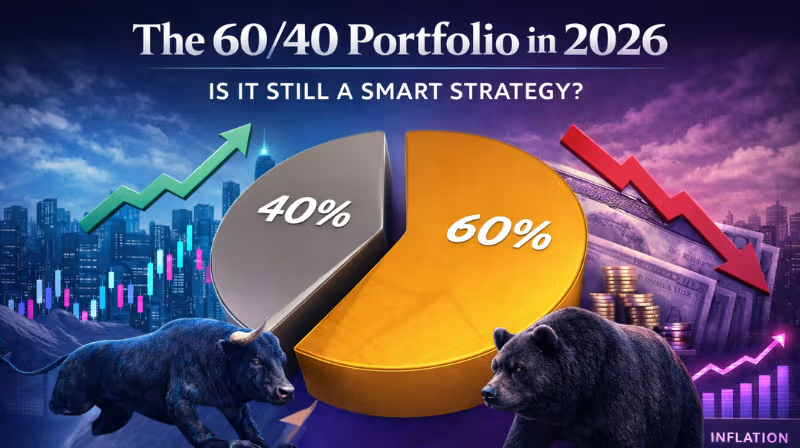
Correlation risk is poorly understood. In normal markets, stocks and bonds often move in opposite directions. But during a genuine crisis — 2008, March 2020 — correlations spike. Assets that appeared uncorrelated fall together. A "diversified" 60/40 portfolio can still lose 30% in a bad year because the diversification only works when you need it least.
Concentration risk is often invisible. High net worth investors frequently have significant wealth tied to a single company, through equity compensation, a business they built, or a long-held position with embedded gains. The rest of the portfolio may look diversified on paper. The full picture often tells a different story.
Tax drag compounds over time. Rebalancing a large portfolio isn't free. Selling appreciated positions triggers capital gains, and for investors in the highest brackets, that can mean losing 20–37% of any rebalancing gain to taxes before you've reinvested a dollar. A strategy that ignores tax efficiency isn't really optimizing for wealth preservation.
Alternative assets become both accessible and necessary. Below a certain threshold, private equity, hedge funds, real estate partnerships, and angel investments are simply out of reach. Above it, they become not just accessible but arguably essential, because they offer return streams that genuinely don't correlate with public markets.
Think of portfolio construction less as a list of holdings and more as a layered architecture. Each layer serves a distinct function, and those layers need to work together.
The foundation of most high net worth portfolios is still public markets. Equities, fixed income, and cash equivalents form the liquid core, providing stability, income, and the flexibility to rebalance or deploy capital quickly.
What changes at higher wealth levels is how you hold that exposure.
Direct indexing replaces mutual funds or ETFs for many investors. Instead of buying a fund that tracks the S&P 500, you own the underlying stocks directly. This enables tax-loss harvesting at the individual security level, which can meaningfully improve after-tax returns over time.
Factor tilts become worth implementing deliberately. Academic research has identified factors, value, quality, momentum, low volatility, small cap, that have historically generated excess returns. A sophisticated investor can tilt equity exposure toward these factors rather than holding pure market-cap-weighted indices.
Fixed income laddering replaces simple bond fund exposure. Owning individual bonds with staggered maturities gives you predictable cash flows, eliminates duration risk from rising rates, and lets you match specific liabilities — like a known expense in year five — to specific assets.
Real assets, primarily real estate, infrastructure, commodities, and natural resources, serve a specific function: inflation protection and low correlation to financial assets.
Real estate deserves particular attention. For high net worth investors, this goes well beyond a primary residence or a rental property. It includes private real estate funds and REITs that provide exposure to commercial, industrial, and multifamily properties; syndications where investors pool capital to acquire specific assets; opportunity zone investments that offer significant tax advantages for those with large capital gains; and ground leases or net lease structures that generate stable, bond-like income.
Real estate's appeal at this level is threefold: it generates income, it appreciates over time, and it often moves independently of stock market cycles. A well-structured real estate allocation can reduce portfolio volatility without sacrificing return.
Infrastructure, toll roads, pipelines, utilities, airports, offers similar characteristics. These assets generate stable cash flows tied to long-term contracts, often with inflation escalators built in. They're deliberately boring, which is exactly what you want from this part of the portfolio.
This is where high net worth investing diverges most sharply from conventional advice. Private markets, private equity, venture capital, private credit, and private debt, have historically delivered returns that exceed public market equivalents, with lower reported volatility (though this partly reflects illiquidity and infrequent pricing rather than genuine smoothness).
Private equity encompasses buyout funds, which acquire and restructure mature businesses, and growth equity, which invests in scaling companies. Top-quartile PE funds have consistently outperformed public equities over long periods, though manager selection matters enormously, the spread between top and bottom quartile managers is far wider than in public markets.
Venture capital sits at the higher-risk end of the spectrum. Most VC investments fail. But the power-law nature of returns — where a small number of investments generate the vast majority of gains, means a diversified VC portfolio can deliver exceptional results. For investors with the stomach for illiquidity and a 7–10 year time horizon, it deserves consideration.
Private credit has grown dramatically since the 2008 financial crisis pushed banks out of certain lending markets. Direct lending funds provide capital to middle-market businesses at floating rates, generating income that typically exceeds what's available in public bond markets at comparable credit quality.
Angel investing warrants its own category. Unlike fund-based private market exposure, angel investing is direct, you're writing checks into individual companies, often at the earliest stages. The returns can be extraordinary, but so can the losses. It requires both capital and genuine involvement to do well.
The fourth layer includes strategies designed to perform when other parts of the portfolio are under stress, or to generate returns that are genuinely uncorrelated with everything else.
Hedge funds vary enormously in strategy, long/short equity, global macro, merger arbitrage, systematic trend-following. The value of hedge fund exposure isn't necessarily higher returns; it's lower correlation. A well-chosen allocation can meaningfully reduce portfolio drawdowns during crisis periods.
Managed futures and trend-following strategies have a particularly interesting track record. They tend to perform best during sustained trends in any direction — including sustained downtrends. In 2022, when both stocks and bonds fell sharply, trend-following funds were among the few strategies that generated positive returns.
Structured products — principal-protected notes, autocallables, and other engineered instruments — allow sophisticated investors to customize their risk/return profile in ways that standard instruments don't permit. These require careful analysis of underlying terms and counterparty risk, but they can serve specific portfolio construction needs.
Commodities and precious metals round out the hedge layer. Gold in particular has a long history as a store of value during periods of currency debasement or geopolitical stress. A modest allocation, typically 3–7%, can provide meaningful protection without dragging on returns in normal environments.
The layered architecture above breaks down into distinct roles, liquidity profiles, and risk characteristics — summarized here for quick reference.
| Layer | Role in Portfolio | Liquidity | Risk / Return Character |
|---|---|---|---|
| Layer 1: Core Public Markets | Liquid foundation — stability, income, and the flexibility to rebalance or deploy capital quickly (equities, fixed income, cash) | Highest — daily tradable; direct indexing and bond laddering used to hold this exposure more precisely | Market-correlated; factor tilts and tax-loss harvesting apply at this layer without changing core liquidity |
| Layer 2: Real Assets | Inflation protection and diversification (real estate, infrastructure, commodities, natural resources) | Low to moderate — private real estate funds, syndications, and infrastructure are multi-year holds; REITs trade daily | Low correlation to financial assets; income-generating with cash flows often tied to long-term, inflation-escalated contracts |
| Layer 3: Private Markets | Return streams that don’t correlate with public markets (private equity, venture capital, private credit) | Lowest — illiquid by design; venture capital commonly requires a 7–10 year time horizon | Historically higher return potential than public equivalents, but manager selection matters enormously and reported lower volatility partly reflects infrequent pricing, not genuine smoothness |
| Layer 4: Alternatives & Hedges | Performance when other layers are under stress (hedge funds, managed futures, structured products, commodities/precious metals) | Varies widely — from exchange-traded gold to multi-year hedge fund lockups | Valued for lower correlation rather than higher returns; were historically less correlated during crisis periods, as trend-following strategies were in 2022 |
As of March 2026, based on 8FIGURES analysis of the endowment-style layered portfolio approach described above; individual fund liquidity terms, minimums, and risk vary by manager and vehicle. Mapping where your own holdings fall across these layers starts with a consolidated view — see 8FIGURES’ Portfolio Analyzer.
With four layers of assets to manage, the question becomes: how do you decide how much goes where?
The most influential framework for sophisticated portfolio construction is the endowment model, pioneered by Yale's David Swensen. The core insight is that institutional investors with long time horizons should accept illiquidity in exchange for higher returns, and should diversify across genuine return sources rather than superficially different asset classes.
Yale's endowment has historically allocated roughly 20–25% to domestic and international equities, 25–30% to private equity and venture capital, 15–20% to real assets, 15–20% to absolute return strategies, and minimal exposure to traditional fixed income.
A direct copy of this model isn't practical for individual investors — you don't have Yale's access, team, or scale. But the principles translate:
Risk parity allocates based on risk contribution rather than dollar allocation. In a traditional 60/40 portfolio, equities contribute roughly 90% of total portfolio risk even though they represent only 60% of the capital. Risk parity corrects this by sizing positions so each asset class contributes equally to overall risk.
In practice, this typically means a smaller equity allocation, a larger fixed income allocation (often leveraged to match equity's risk contribution), and meaningful commodity and real asset exposure. Risk parity portfolios tend to be more stable across economic environments because they're not implicitly betting on equities outperforming. The tradeoff is that achieving equity-like returns usually requires leverage, which introduces its own risks.
For investors with known future obligations, a business acquisition, a large charitable commitment, estate planning distributions, a liability-matching approach makes sense. Rather than optimizing the portfolio in isolation, you explicitly match assets to liabilities.
Short-term liabilities (0–3 years) get funded with cash and short-duration bonds. Medium-term liabilities (3–10 years) get funded with laddered bonds and stable income assets. Long-term liabilities (10+ years) get funded with growth assets — equities, private markets, real assets.
The advantage is that it eliminates the risk of being forced to sell growth assets at depressed prices to meet near-term obligations. It also clarifies how much of the portfolio is truly long-term money that can tolerate illiquidity.
One of the most common and most dangerous problems in high net worth portfolios is concentration risk that isn't visible at the surface level.
Consider a founder who has sold a company and now holds $10 million in diversified investments. The portfolio looks well-diversified across stocks, bonds, and alternatives. But if 40% of the equity exposure is in technology stocks, the primary residence is in a tech-heavy city where real estate values track tech company performance, and the angel investments are all in tech startups, the actual concentration is far higher than it appears.
Mapping true correlations requires looking through the portfolio to understand what economic factors actually drive returns. Two assets can look different on paper but be driven by the same underlying risks.
Managing equity compensation concentration is a specific challenge for executives and founders. Concentrated positions in a single stock often carry large embedded gains that make outright sale expensive. Strategies for managing this include exchange funds, which let you contribute concentrated stock and receive a diversified portfolio in return while deferring taxes; protective puts and collars that limit downside while preserving upside; charitable remainder trusts that allow diversification while generating income and a charitable deduction; and systematic selling programs that spread the tax impact over multiple years.
None of these are perfect. Each involves tradeoffs between tax efficiency, cost, and risk reduction. But ignoring concentration risk because the tax bill is painful isn't a strategy, it's a gamble.
Most high net worth investors are significantly underweight international assets relative to global market weights. Home country bias is understandable, you know your home market better, your liabilities are in your home currency, and domestic assets feel familiar. But it comes at a cost.
International diversification provides exposure to different economic cycles, different currency dynamics, and different valuation environments. When U.S. equities are expensive by historical standards, emerging markets or European equities may offer better value. When the dollar weakens, international assets appreciate in dollar terms.
A sophisticated international allocation goes beyond buying an international equity ETF. Developed market equities in Europe, Japan, and Australia provide exposure to different economic cycles and often trade at lower valuations than U.S. equities. Emerging market equities offer higher growth potential alongside higher volatility and political risk. International real estate through global REITs or direct investment, foreign currency exposure as a deliberate hedge against dollar weakness, and international private markets — European buyout funds, Asian venture capital — round out the picture for investors with the access and sophistication to evaluate them.
Rebalancing a complex, multi-asset portfolio is genuinely difficult, and the challenges multiply with portfolio size. Large positions can't be liquidated without market impact. Tax-efficient rebalancing requires careful coordination across accounts. Illiquid assets rebalance on their own timeline, not yours. And different accounts — taxable, IRA, trust — have different tax treatments that affect where assets should be held.
Tax-aware rebalancing means prioritizing sales in tax-advantaged accounts, using new contributions to rebalance toward underweight positions rather than selling overweight ones, and harvesting losses to offset gains when rebalancing is necessary.
Tolerance band rebalancing — rather than rebalancing on a calendar schedule — means only acting when allocations drift beyond a defined threshold, say five percentage points from target. This reduces transaction costs and tax drag while still maintaining the portfolio's intended risk profile.
Asset location is an underappreciated source of after-tax return. High-yielding assets like bonds, REITs, and private credit belong in tax-advantaged accounts. Tax-efficient assets like index funds and growth equities belong in taxable accounts. Getting this right can add meaningful after-tax return over time without changing the portfolio's risk profile at all.
Here's a practical problem that doesn't get enough attention: as portfolios grow more sophisticated, they become harder to see clearly. A brokerage account here, a crypto wallet there, a stake in a private fund, a rental property, an angel investment — and no single place where the whole picture comes together.
This visibility problem is more dangerous than it sounds. Without a consolidated view of your entire net worth, you can't accurately assess your true asset allocation, identify hidden concentrations, or make informed rebalancing decisions. You're navigating without a map.
This is exactly the problem that 8FIGURES is built to solve. The platform lets you link your brokerage, bank, and crypto accounts in one place, giving you a consolidated view of your net worth across asset classes — stocks, bonds, crypto, real estate, angel investments, and private funds. The AI-powered insights layer surfaces rebalancing recommendations and portfolio analysis without the cost of a traditional wealth advisor. And because the platform is read-only by design, it analyzes your portfolio without ever being able to touch your funds.
For investors managing complex, multi-asset portfolios, that kind of clear visibility isn't a luxury. It's the foundation that every other strategy depends on.
%2520(1).avif)
Sophisticated diversification doesn't happen all at once. It's built deliberately over time. Here's a practical sequence for getting there.
Get a complete picture first. Before making any allocation changes, understand exactly what you own across all accounts and asset classes. Map your true exposures, not just your stated allocations.
Identify your biggest risks. Is it concentration in a single stock or sector? Overweight to public equities? Insufficient inflation protection? Inadequate liquidity? Name the specific risks before trying to fix them.
Define your time horizons and liquidity needs. How much of your portfolio is genuinely long-term money? What are your known near-term obligations? This determines how much illiquidity you can afford to accept.
Build toward your target allocation gradually. Tax-efficient transitions take time. Rushing to rebalance can trigger unnecessary tax bills. Prioritize the highest-impact changes first.
Review and rebalance systematically. Set tolerance bands. Review allocations at least annually. Use new contributions to rebalance toward underweight positions wherever possible.
Reassess as circumstances change. A portfolio that was right at 40 may not be right at 55. Business sales, inheritance, retirement — life events change your risk profile and your liquidity needs. The portfolio should evolve with you.
Portfolio diversification at the high net worth level is less about following a formula and more about building a coherent strategy that matches your specific circumstances, risk tolerance, and goals. The principles, true diversification across uncorrelated return sources, tax efficiency, concentration risk management, and clear visibility, are consistent. The implementation varies by individual.
What doesn't vary is the cost of getting it wrong. Concentration risk, tax drag, and poor asset location can quietly erode returns for years before the damage becomes visible. The investors who build lasting wealth at this level are the ones who take portfolio architecture seriously — not just when markets are volatile, but as an ongoing discipline.
If you’re managing a complex portfolio across multiple accounts and asset classes, start with visibility. You can’t optimize what you can’t see, which is why platforms like 8FIGURES can play an important role in helping investors bring clarity, structure, and oversight to complex wealth.
Managing your investments has never been easier!