

Try it now!
Managing your investments has never been easier!





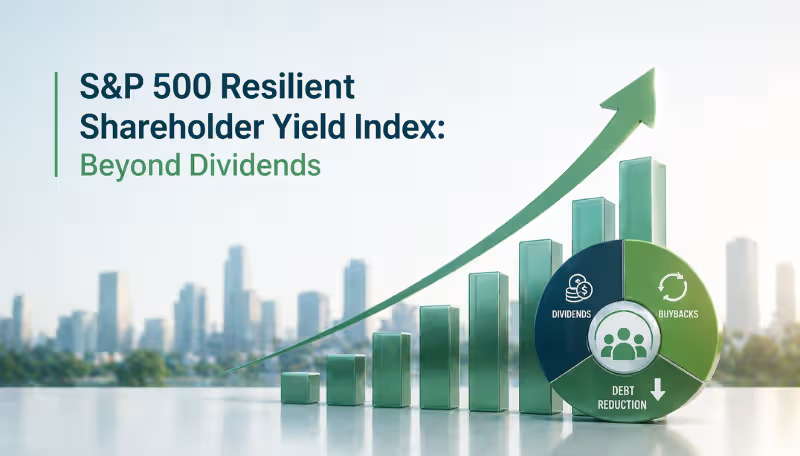

In today's investment landscape, evaluating shareholder returns requires looking beyond dividend yields alone. Traditional reliance on dividends neglects other vital methods companies use to reward investors, such as share repurchases and debt reduction. Collectively, these actions comprise the concept of shareholder yield, a broader metric that captures total capital returned to shareholders.
This article explores the S&P 500 Resilient Shareholder Yield Index, a pioneering benchmark that identifies firms excelling in comprehensive shareholder remuneration. We analyze its structure, defensive performance during volatile markets, and spotlight three compelling companies exemplifying this strategy: 3M, Synchrony Financial, and Jabil.
Investors traditionally gauge company generosity based on dividend yields. However, dividends alone do not paint the full picture. Companies increasingly employ multiple capital return strategies, including:
William Priest and Mebane Faber popularized this inclusive approach to shareholder return as the shareholder yield framework. According to S&P Dow Jones Indices, the twelve months through September 2025 saw S&P 500 companies pay out a record $664.9 billion in dividends. Yet, total capital returned—combining dividends and buybacks—tallied a whopping $1.685 trillion, indicating buybacks overshadow dividends by more than a 1.5:1 ratio.
Shareholder yield is calculated as the sum of cash dividends, net share repurchases (buybacks minus new issuances), and net debt reduction divided by market capitalization. Including debt reduction is crucial since lowering liabilities improves future distributable income, essentially shifting value from creditors to shareholders in a tax-efficient manner.
This comprehensive metric enables investors to better assess true shareholder return policies and has inspired innovative index strategies challenging traditional benchmarks.
Launched in late 2024, the S&P 500 Resilient Shareholder Yield Index selects the top 100 companies with superior shareholder yield profiles, while excluding financials and most real estate firms due to their distinctive balance sheets. Companies with aberrantly high yields (>25%) are also removed to avoid potential "yield traps." Remaining constituents are ranked by a composite score blending return on equity, free cash flow to debt ratio, shareholder yield, and growth of capital returned over five years.
A backtest covering the period from June 2000 to September 2025 showed that the S&P 500 Resilient Shareholder Yield Index delivered a 10.62% CAGR, compared with 8.2% for the S&P 500. From the start of the current year through April 15, the S&P 500 Resilient Shareholder Yield Index gained 7.41%, while the S&P 500 rose 2.1%.
This index not only delivers superior returns but also offers downside protection. During periods with the VIX exceeding 30, it outperformed the S&P 500 by 0.92 percentage points on average and by 0.67 points when the VIX ranged between 25 and 30. Its downside capture ratio of 81.87% indicates lower losses during market downturns.
Backtesting through the 2007–2009 financial crisis shows a maximum drawdown of 43.73% compared to 48.81% for the S&P 500, illustrating more resilient performance amidst turbulence.
The index notably minimizes exposure to the dominant "Magnificent Seven" technology giants, encompassing instead a more balanced sector distribution. Industrial, consumer staples, and energy sectors receive higher weightings relative to the S&P 500, while concentration risks are reduced with single-stock weights capped at 4.5% and sector weights limited to 40%.
Major holdings include Exxon Mobil, representing roughly 6.1% due to rebalancing lag, with the average constituent market cap at $63.6 billion.
Constituents typically trade at lower valuation multiples, reflecting mature businesses with steady cash flow and shareholders-focused capital policies. Earnings growth expectations are reflected in a notable forward P/E of 13.68 versus a current P/E of 22.54, signaling anticipated profit expansion.
Investors can access this strategy through the XUDY ETF listed on XETRA.
Operating globally since 1902, 3M delivers diversified products across safety, industrial, transportation, electronics, and consumer goods. Key innovations include advanced adhesive tapes enhancing AI infrastructure and solar panel films for satellites, underpinning a robust patent portfolio.
3M is actively executing a three-stage transformation plan focusing on foundational improvements, operational simplification, and high-margin growth verticals. In 2025, product launches surged 70% over the prior year, with new goods contributing significantly to sales growth.
Despite macroeconomic headwinds, 3M recorded modest revenue gains alongside ongoing investments in R&D. The company initiated a $7.5 billion unlimited-duration buyback program in 2025, repurchasing $3.3 billion in shares and maintaining nearly a century of dividend payments with a forward yield of 2.05%.
Legal challenges related to PFAS liabilities present risks, but 3M’s strong innovation pipeline and shareholder-friendly capital returns support a positive valuation outlook.
Synchrony offers consumer financing products, including credit cards and installment loans, partnering with leading retailers such as Amazon and Walmart. Its diversified business spans home and auto financing, digital platforms, retail, health and wellness, and lifestyle sectors.
In 2025, Synchrony improved net income by 1.5%, driven by lower credit losses and higher net interest income. Its customer base maintains strong credit quality, with over 70% prime or super-prime borrowers, supporting portfolio stability.
The company returned $2.9 billion to shareholders via buybacks and dividends, priced attractively relative to peers, with a forward dividend yield of 1.59%. Capital adequacy remains robust, with CET1 ratios comfortably above regulatory requirements.
Jabil is a leading contract manufacturer specializing in electronics and industrial components, operating across multiple regions globally. Business segments include regulated industries, intelligent infrastructure, and connected living.
The company benefits from the booming AI and digital economy sectors, with significant revenue growth propelled by increased demand for AI infrastructure components. Operational efficiency improvements and a focused restructuring program bolster profitability.
Jabil maintains disciplined capital management, with stable quarterly dividends and active share repurchases totaling $666 million in 2026 to date.
The S&P 500 Resilient Shareholder Yield Index demonstrates the power of comprehensive shareholder return metrics in identifying firms that not only provide sustainable income but also resilient performance amid market volatility. Companies like 3M, Synchrony Financial, and Jabil illustrate how innovation, financial strength, and shareholder-friendly policies can create compelling investment opportunities.
For investors seeking enhanced total return avenues beyond conventional dividends, integrating shareholder yield analysis and considering adoption of such focused indices can add significant value to portfolio strategy.
To explore AI-driven portfolio insights and strategies tailored for sophisticated investors, consider exploring 8FIGURES.
Managing your investments has never been easier!