

Try it now!
Managing your investments has never been easier!





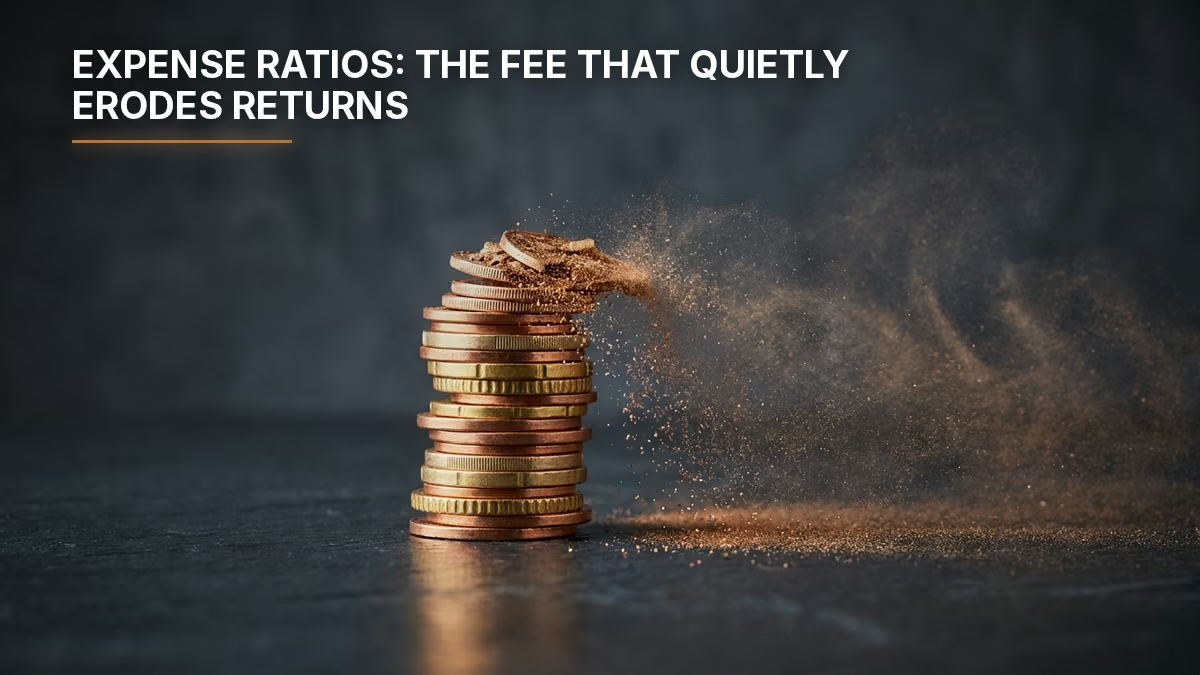

A comprehensive guide to deconstructing fund fees, analyzing the compounding drag of expense ratios, and optimizing your portfolio for long-term wealth preservation.
The short version: Expense ratios represent the ongoing operational fees charged by mutual funds and exchange-traded funds (ETFs) to cover management and administrative costs. Over long horizons, even seemingly minor percentage-based fees compound significantly, creating a substantial drag on overall portfolio returns. (Understanding Fees | Investor.gov; The Hidden Fees of Investing & How They're Eroding Your Returns | Consilio Wealth Advisors)
When building a long-term investment portfolio, investors often focus heavily on asset allocation, historical performance, and market timing. However, one of the most critical determinants of your ultimate net wealth is the ongoing cost of holding your investments. Funds pass their operational costs along to shareholders in the form of various fees and expenses, which are collectively expressed as an expense ratio.
An expense ratio is a fee charged by a mutual fund or exchange-traded fund (ETF) to cover the costs of managing the fund. While these fees may seem small, over time they can have a major impact on your investment portfolio.
To evaluate whether a fund is priced fairly, you must understand what its expense ratio actually pays for. The total fee is not a single monolithic charge; rather, it is a bundle of distinct operational expenses incurred by the fund sponsor. Some ETFs charge specifically for management or operational expenses to keep the fund running. Furthermore, management fees may also include administrative fees payable to the investment adviser that are not included in the "Other Expenses" category. This "Other Expenses" category covers mutual fund or ETF expenses other than management fees and 12b-1 fees. When evaluating these costs, investors should ask whether the adviser's administrative services are bundled or billed separately, and consider how these distinct operational layers might impact the fund's overall efficiency. (Mutual Fund and ETF Fees and Expenses – Investor Bulletin | Investor.gov; How to evaluate ETFs: 6 things that matter most)
The true danger of expense ratios lies in the mathematics of compounding. Just as your investment returns compound over time, the fees you pay also compound, depriving you of capital that would otherwise have grown. A fund with high costs must perform better than a low-cost fund to generate the same net returns for you.
To illustrate this compounding drag, consider the long-term impact of fees on a substantial portfolio. For example, a $100,000 investment that grows at an annual rate of 4% over a 20-year period will experience significantly different terminal values depending on the fee structure applied to it. (How Fees and Expenses Affect Your Investment Portfolio – Investor Bulletin | Investor.gov)
Part of what makes this drag so easy to overlook is the way the cost reaches you. A fund does not send its shareholders a separate invoice; instead, it passes its costs along to shareholders in the form of various fees and expenses. Because the charge is built into the fund rather than billed to you directly, it is easy to hold a fund for years without ever scrutinizing the percentage you are paying, even though that percentage applies every single year.
Beyond the headline expense ratio, you may also encounter the terms “fee waiver” and “expense reimbursement” when reviewing a mutual fund or ETF. Because a fund's costs can be described in more than one way, it is worth reading the fund's own current documentation, such as its prospectus, so you understand the specific fees and expenses that apply to your own investment before committing capital. Taking the time to understand this terminology makes it easier to compare the true, all-in cost of two funds that might otherwise appear similar at first glance.
The structural wrapper of your investment—whether it is an exchange-traded fund (ETF) or a mutual fund—plays a massive role in determining its expense ratio. Over the last 27 years, ETFs have become an increasingly popular investment vehicle, providing investors with a diverse set of options and serving as a popular trading tool in secondary markets. (the SEC)
ETFs generally enjoy significant cost advantages over mutual funds. Academic research comparing passive mutual funds to ETFs that track the exact same index and are managed by the same financial services firm highlights this disparity. The study found that the average annual expense ratio for passive mutual funds is 0.45%, which is more than double the ETF average annual expense ratio of 0.21%. Because funds pass these costs along to shareholders in the form of various fees and expenses, this structural cost difference creates an immediate performance drag for mutual fund investors. When building a portfolio, a critical decision checkpoint is evaluating whether the convenience of a mutual fund wrapper justifies paying more than double the annual operating expenses of an equivalent ETF.
This cost gap tends to show up in performance. Academic research indicates that passive mutual funds underperform their ETF counterparts by 42 basis points in annualized returns. Management style also plays a part: the same study tracked actively managed mutual funds from the same firm and found that their stock returns outperformed the passive funds by 31 basis points. These findings underline why the structure and cost of a fund, not past returns alone, deserve close attention when you weigh two otherwise similar options.
| Fund Wrapper & Style | Average Annual Expense Ratio | Annualized Performance Impact |
|---|---|---|
| Passive Mutual Funds | 0.45% | Underperform ETF counterparts by 42 basis points |
| Exchange-Traded Funds (ETFs) | 0.21% | Baseline cost advantage over passive mutual funds |
| Active Mutual Funds | Varies | Outperform passive funds by 31 basis points in stock returns |
| General Fund Holdings | Varies | High costs require higher performance to match low-cost returns |
To protect retail investors, regulatory bodies enforce strict disclosure requirements. The Securities and Exchange Commission (SEC) has adopted rules and form amendments to ensure that investors have access to clear, useful information regarding fund costs.
Under SEC Rule 6c-11, the regulatory framework has been modernized to replace older exemptive orders. This rule relies heavily on daily portfolio transparency, which supports the arbitrage mechanism that keeps ETF market prices aligned with their underlying assets. Additionally, disclosure amendments to Form N-1A and Form N-8B-2 ensure that investors purchasing shares on the secondary market receive comprehensive information regarding trading and associated costs. This regulatory structure is particularly relevant because ETFs have become an increasingly popular investment vehicle over the last 27 years, providing investors with a diverse set of investment options. They also have become a popular trading tool, making up a significant portion of secondary market equities trading. Investors should monitor these disclosures to evaluate secondary market liquidity and trading spreads.
Regulators also set expectations for how these costs are communicated. The SEC's guidance on reasonable disclosure addresses both the form and manner in which fee information is presented and the timing and frequency with which it must be provided, helping investors locate and compare a fund's costs before they invest. These requirements exist so that cost information is neither buried nor delayed, giving investors a fair basis on which to compare one fund against another. (Federal Register :: Regulation Best Interest)
Optimizing your portfolio requires active comparison and a clear understanding of all associated costs. Investors should not evaluate funds in isolation but should instead utilize specialized tools to compare options side-by-side. You can compare ETFs side-by-side with a brokerage research platform or ETF search tools. This side-by-side comparison allows you to evaluate key metrics such as expense ratios, historical tracking error, and trading volume. A key decision checkpoint is determining whether a fund's underlying holdings provide the precise asset class exposure you need. Additionally, investors should check if their brokerage platform charges transaction fees for trading specific ETFs, as these transaction costs can quickly offset any savings gained from a lower expense ratio.
You can use FINRA’s Fund Analyzer to compare the fees, expenses, and other costs of different mutual funds and ETFs. This tool helps you visualize how different fee structures will impact your wealth over your specific holding period. For example, the impact of three different fees on a $100,000 investment that grows 4% annually over 20 years demonstrates how small differences compound. By inputting your specific holding period and expected rate of return, you can identify the exact point where a lower-cost fund significantly outperforms a higher-cost alternative. This analysis provides a clear decision checkpoint for long-term asset allocation, helping you avoid funds that charge high fees for identical market exposure.
Additionally, remember that expense ratios are only one part of the total cost of ownership. When managing a portfolio, you must also account for other potential leakages. For instance, the expenses for operating and administering a retirement plan, such as a 401(k) or 403(b), may be passed along to its participants, further impacting your net returns. Weighing these layered costs together, rather than fixating on the expense ratio alone, gives you a more accurate sense of what your portfolio truly costs to run each year.
| Cost Category | Impact on Portfolio | Mitigation Strategy |
|---|---|---|
| Fund Expense Ratios | Deducted continuously; compounds into significant wealth erosion over 20-30 years | Compare funds using FINRA's Fund Analyzer and favor low-cost ETFs |
| Retirement Plan Admin Fees | Passed along to 401(k) or 403(b) participants, reducing net retirement savings | Review plan disclosure documents and select lower-cost underlying funds |
| Advisory & Planning Fees | Ongoing fees for professional management and comprehensive financial planning | Work with advisors who offset costs through tax strategies and estate planning |
| Trading & Transaction Costs | Secondary market trading costs and bid-ask spreads on ETF transactions | Utilize brokerage platforms to evaluate trading costs and bid-ask spreads |
This guide is for educational purposes only and does not constitute formal tax, legal, or investment advice. While minimizing fees is a critical component of successful investing, financial advisors who focus on providing comprehensive financial planning, tax strategies, and estate planning can often cover their costs through reduced taxes and by ensuring your financial plan remains on track for success. Always consult a qualified professional before making major investment decisions.
Use 8FIGURES to inspect your portfolio inputs and prepare better questions for your own review.
Managing your investments has never been easier!