



Try it now!
Managing your investments has never been easier!


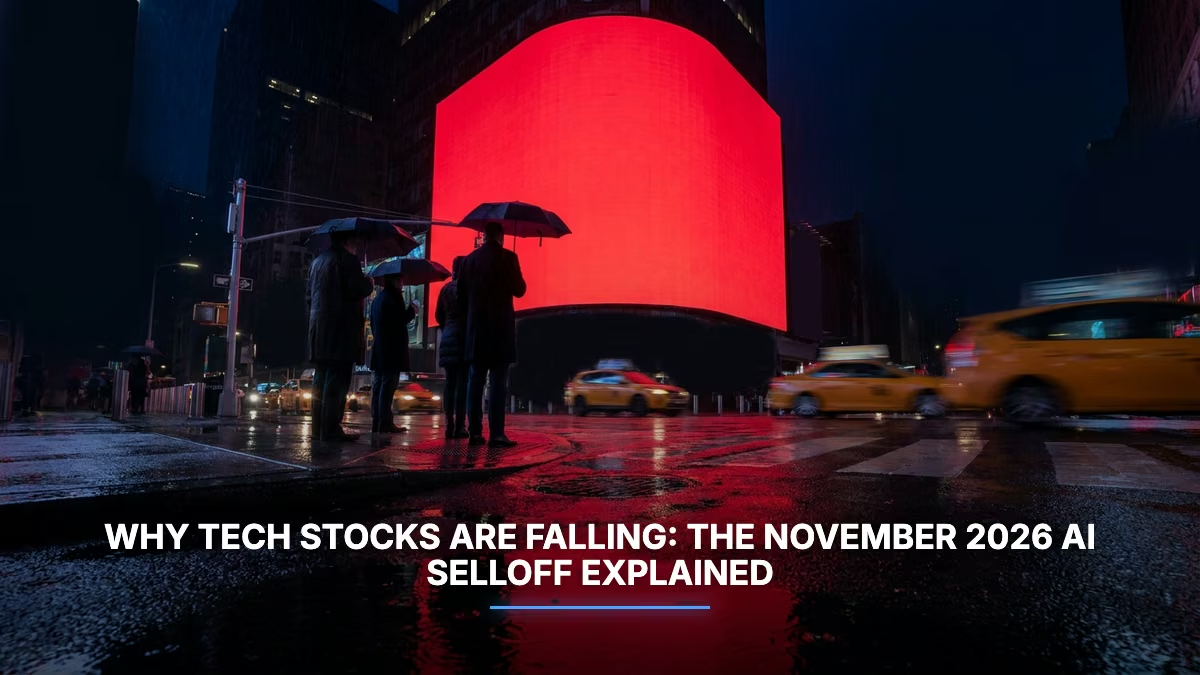

Why AI and chip stocks led the November 2026 selloff: Nvidia’s slide and CEO exit, the midterm hit to data-center plans, and an Anthropic IPO that failed to turn the tide.
The short version: Tech stocks fell in November 2026 because investors turned on the AI trade. Nvidia, the face of the AI boom, dropped 9.3% in one day and its CEO resigned after a scandal, the Nasdaq slid more than 10% below its record, and the midterm results raised the risk that data-center construction slows. Even Anthropic’s record IPO did not stop the slide. (A brutal sell-off for AI stocks sends Wall Street reeling, and the S&P 500 tumbles 4.4% - Los Angeles Times; Anthropic shares slide as AI sell-off hits global markets - as it happened | Business | The Guardian; Anthropic sets share price at $83 for stock market debut, above expected range | Anthropic | The Guardian)
The technology sector experienced a significant market correction in November 2026, bringing an abrupt pause to the multi-year rally led by artificial intelligence. This market volatility was not confined to a single sub-sector; it swept across semiconductor manufacturers, data center construction firms, and the broader supply chain that supports high-performance computing infrastructure. Investors must evaluate whether this correction represents a temporary pause or a structural shift, as any slowdown in the construction of AI data centers directly translates to fewer purchases of AI chips, electricity, and other services that have been driving U.S. economic growth. (AI Stocks Crash: What Happened in November 2026 — Finlume)
On November 19, 2026, Wall Street experienced severe downward pressure as major chip designers and other highly valued technology stocks swung lower. This downward momentum triggered a broader global equity slide. The MSCI World Index fell for seven consecutive trading sessions, marking its longest sustained losing streak since 2023. Meanwhile, European equities felt the pressure as the STOXX 600 index dropped 1.5% in morning trading on the day of the slide, leaving it down 5% from its record high achieved on November 12, 2026. This global retreat was further illustrated on Friday when Asian stocks plunged by up to 4% in early trading, demonstrating that even a historic market debut did little to settle nerves across international trading floors. (Global Stocks slide as AI selloff deepens, Asia set for worst week since 2020 - DD India)
To help investors visualize the scale of this market movement, the table below outlines key market indicators during the mid-November 2026 correction period. This data highlights the rapid valuation adjustments across major global indices, the sudden shift in investor sentiment, and the corresponding volatility that impacted leading technology and semiconductor equities during this turbulent trading window.
| Market Indicator | Observed Performance / Milestone | Primary Impacted Sector |
|---|---|---|
| MSCI World Index | 7-session consecutive decline (longest since 2023) | Global Equities |
| STOXX 600 Index | Fell 1.5% in morning trading; down 5% from Nov 12 peak | European Equities |
| AI Supply Chain | Sharp downward swings on November 19, 2026 | Semiconductors & Data Centers |
The selloff hit hardest at the center of the AI boom. On November 5, Nvidia, the chip company that became the face of the boom, fell 9.3% and was by far the heaviest weight on the S&P 500. Advanced Micro Devices fell 17.3% and CoreWeave, which rents out AI chips over the cloud, 9.8%. By that day’s close the Nasdaq, full of AI and other tech stocks, was 11.9% below the record it set in October, past the 10% drop usually called a correction.
Nvidia’s trouble went beyond its share price. A scandal led its chief executive, Jensen Huang, to resign, and investors began to worry about Nvidia’s role as a backstop for the whole AI ecosystem. The selling carried into the week of Anthropic’s debut: on November 19 the Nasdaq fell 2.3% and the S&P 500 2%, its sixth losing session in a row, and before the open on November 20 Nvidia was down about 2.7% and AMD about 5.4%.
The largest companies tend to fall together because their businesses are tied together. Amazon and Alphabet hold meaningful stakes in Anthropic while also serving as its main cloud providers, and Nvidia has invested in Anthropic, OpenAI and CoreWeave, the same companies that buy its chips. Morningstar estimates that Alphabet, Amazon, Microsoft and Oracle together committed about $750 billion to capital spending in 2026, so a doubt about AI demand reaches all of them at once.
| Company | What happened in November 2026 |
|---|---|
| Nvidia | Fell 9.3% on November 5, the heaviest weight on the S&P 500; CEO Jensen Huang resigned after a scandal |
| Advanced Micro Devices | Fell 17.3% on November 5, and about 5.4% before the open on November 20 |
| CoreWeave | Fell 9.8% on November 5 |
| Amazon and Alphabet | Hold stakes in Anthropic and serve as its main cloud providers |
| Alphabet, Amazon, Microsoft and Oracle | Committed about $750 billion to 2026 capital spending, by Morningstar’s estimate |
A primary catalyst for investor anxiety was the shifting political and regulatory landscape following the US midterm elections. For several years, the rapid buildout of physical data centers had proceeded with minimal municipal friction. However, local communities have increasingly voiced concerns over the immense resource consumption associated with these facilities, particularly their high electricity and water demands. Across the United States, opposition has manifested in active protests against local data center plans, with multiple municipalities and states voting for bans or restrictions on them during the midterm elections. Furthermore, technology leaders must prepare for potential federal policy shifts next year when Democrats take over both chambers of Congress after securing large majorities.
The highly anticipated public debut of Anthropic on the Nasdaq Global Select Market under the ticker symbol ANT was supposed to restore confidence to the technology sector. Instead, the historic offering highlighted a deep liquidity drain and intensified market volatility. The registration statement for the offering was declared effective by the Securities and Exchange Commission on November 18, 2026, with official trading commencing on November 19, 2026. Despite pricing its initial public offering of 825,000,000 Class A shares above its expected range of $70.00 to $78.00 per share, the company's shares slumped at the start of trading on Friday, November 20, 2026, as the debut failed to stem the broader sell-off in AI-linked companies. (Anthropic prices initial public offering \ Anthropic; Anthropic IPO Tracker: Date, Valuation and S-1 Status)
Anthropic priced its initial public offering of Class A common stock at $83 per share, which was above its previously expected roadshow range of $70 to $78 per share. The company offered 825,000,000 Class A shares. In addition to the public offering, major technology partners—including AMD, Broadcom, Google, Micron, Microsoft, NVIDIA, and TSMC—committed to purchasing $26.0 billion of Class N common stock in a private placement scheduled to close immediately after the IPO.
Despite raising a record amount of capital, the debut failed to stem the broader selloff. In early trading on Friday, November 20, 2026, Anthropic’s shares slumped along with a broader decline in global markets.
The November 2026 correction forced investors to look past top-line revenue growth and scrutinize the underlying cash flow dynamics of the industry. Anthropic's S-1 filing illustrated this fundamental tension. The company demonstrated explosive revenue growth, reporting $41 million in 2023, $386 million in 2024, and $4.585 billion in 2025. For the first six months of 2026 alone, revenue reached $16.286 billion, and third-quarter 2026 revenue came in at $16.96 billion—representing an 1,127% increase from the prior year's third quarter.
However, this massive growth came at an extraordinary cost. Anthropic disclosed a net loss of $80 billion for the first half of 2026. Its third-quarter results showed a $567 million operating loss alongside a net loss of $23.29 billion. While the company held $131.8 billion in cash, cash equivalents, and short-term investments as of September 30, 2026, to carry short-term compute costs, research analysts at Goldman Sachs expect the company to take until 2030 to generate positive free cash flow on an annual basis. This long path to profitability is further complicated by massive long-term commitments, including promises to spend approximately $900 billion on data center infrastructure over the next two decades, which experts warn is likely to drive the company's debt levels even higher.
This capital-intensive reality is mirrored across the entire ecosystem. The leading hyperscalers—Alphabet, Amazon, Microsoft, and Oracle—collectively committed approximately $750 billion to capital expenditures in 2026, with spending expected to approach $1 trillion in 2027. This massive scale of expenditure highlights why the financing of the AI ecosystem has become a central question weighing on the market at large.
For long-term investors, the question is whether this is a short-term swing or a lasting change in the AI trade. The cost of financing data centers and the chance that governments slow their construction both bear on future demand for AI chips, electricity and the services around them, and that is what the market has been repricing.
This matters even for investors who never bought a chip stock. Because AI chip makers are now among the largest U.S. companies, a 1% move in Nvidia has more effect on the S&P 500 than a 1% move in nearly any other U.S. stock. A broad index fund therefore carries more exposure to the AI trade than its 500 names suggest, and checking how much of a portfolio sits in a handful of large tech companies is a sensible first step.
If Anthropic qualifies for early inclusion, it could join major indexes such as the Russell 1000 and the Nasdaq 100 as soon as December.
To achieve a real sense of stability, investors must monitor how the political climate for data centers shapes up, how the Nvidia situation evolves, and what happens with OpenAI. In the near term, companies like Anthropic rely on substantial cash and short-term investments to carry short-term compute costs while long-term capacity comes online.
Taxes, liquidity restrictions, investment concentration and long-term goals all matter, and they differ from one investor to the next. Consider talking to a qualified tax, legal or investment professional before making significant changes to your portfolio. (Anthropic Employee Equity Planning: Taxes & Wealth Management - Inclinevest Wealth Management)
Use 8FIGURES to inspect your portfolio inputs and prepare better questions for your own review.
Educational Disclaimer: This article is for informational purposes only and does not constitute investment, legal, or tax advice. Market conditions are subject to rapid change, and past performance is not indicative of future results.
Managing your investments has never been easier!