
Try it now!
Managing your investments has never been easier!







The SpaceX IPO could become one of the biggest market events of 2026, with reports pointing to a possible June listing. Other major private AI companies, including Anthropic and OpenAI, are also reportedly preparing for potential public offerings, raising the prospect of a new wave of mega-IPOs. For investors, one tempting strategy is to buy newly public companies before they are added to major stock market indexes. Index inclusion can create additional demand from passive funds and ETFs that track benchmarks such as the S&P 500, Nasdaq indexes, or broader total-market indexes.
But the index-inclusion trade is more complicated than it looks. Investors need to estimate how much passive buying could actually occur, when index funds would need to buy, and whether the expected inflows are already reflected in the stock price. A large IPO does not automatically mean immediate inclusion in every major index.
The key variables are specific and technical: the company’s free float, float-adjusted market capitalization, liquidity, index-provider eligibility rules, rebalance dates, and the amount of capital tracking the relevant benchmark. In the case of SpaceX, OpenAI, or Anthropic, these details could determine whether index inclusion becomes a real catalyst for the stock, or simply a widely anticipated event that the market prices in long before passive funds arrive.
The rise of mega-IPOs is fundamentally transforming index inclusion protocols. In the past decade, many tech companies remain private longer and debut publicly with valuations soaring into tens of billions, disrupting traditional index practices. Consider Arm, the UK chip design firm, which post-IPO in September 2023 was valued at $54.5 billion. Similarly, CoreWeave, a projected AI hyperscaler IPO candidate for 2025, is estimated to reach a $61 billion valuation by April 2026. Such massive valuations prompt index providers to adapt swiftly, ensuring indices remain accurate market barometers.
Where index providers once waited several quarters post-IPO to add companies, accelerated inclusion procedures—introduced by S&P Dow Jones Indices in 2019—now enable faster integration of major IPOs into measures like the S&P Total Market Index. Still, premier indices such as the S&P 500 require a 12-month public trading tenure alongside rigorous criteria, balancing quality, earnings stability, and liquidity management.
Index providers prioritize free-float, the shares actively available for public trading, over total market capitalization. Founders and early investors often lock substantial shares, limiting the tradable float and affecting technical demand dynamics.
For example, after SoftBank's acquisition of Arm, approximately 90.6% of shares remained locked up, leaving only 9.4% as free float. Although Arm cleared size thresholds for index inclusion, this low free-float heightened sensitivity to passive buying pressure.
Different index providers impose varied inclusion rules. The S&P 500 uses a committee combining strict quantitative screens and discretion, while Russell indexes assess IPOs quarterly based on market cap and trading history, requiring public float and size benchmarks aligned with the Russell 3000E.
When a stock is added to an index, the funds tracking that index must buy shares proportionally to mirror the benchmark, typically during scheduled rebalancing events—often the third Friday in March, June, September, and December for Russell indexes.
This buying is mechanical, aimed at minimizing tracking error, and independent of company fundamentals. This differs sharply from active investors driven by intrinsic company value. The scale of buying depends on the amount of assets linked to the index.
To illustrate, FTSE Russell estimates $10.6 trillion are benchmarked to Russell indexes, while the largest ETFs tracking the S&P 500 (SPY, VOO, IVV) hold a combined $2.3 trillion as of April 2026.
Purchasing shortly after IPO aims to capture predicted demand before it is fully priced in. This stage is volatile and speculative but may offer attractive entry points if one accurately forecasts inclusion likelihood.
Investors can position holdings as inclusion likelihood becomes clearer, utilizing issuer and index provider communications and scheduled rebalancing insights. Transparency in Russell’s quarterly schedule enables tactical positioning.
Buying at the moment the index inclusion is officially confirmed targets the gap between market anticipation and actual buying by funds. Tesla’s S&P 500 announcement in November 2020 spurred a 14% single-day jump preceding a nearly 70% gain at inclusion.
Seasoned traders may exploit price swings driven by forced buying or selling near rebalance cutoffs. Understanding liquidity providers, arbitrageurs, and insider activity is critical. Limited free float can magnify gains but raises risk.
Post-inclusion, the artificial demand subsides, often leading to price pullbacks if fundamentals don't justify premiums. Investors can realize profits or capitalize on corrections, a pattern increasingly seen as markets evolve.
The historical returns from index-inclusion trades can look impressive, but they should be treated as reference calculations rather than guaranteed trading results. The examples below use specific event dates: the first formal signal of possible index inclusion and the date when the company was actually added to the index — or, in Robinhood’s case, when expected inclusion failed to happen.
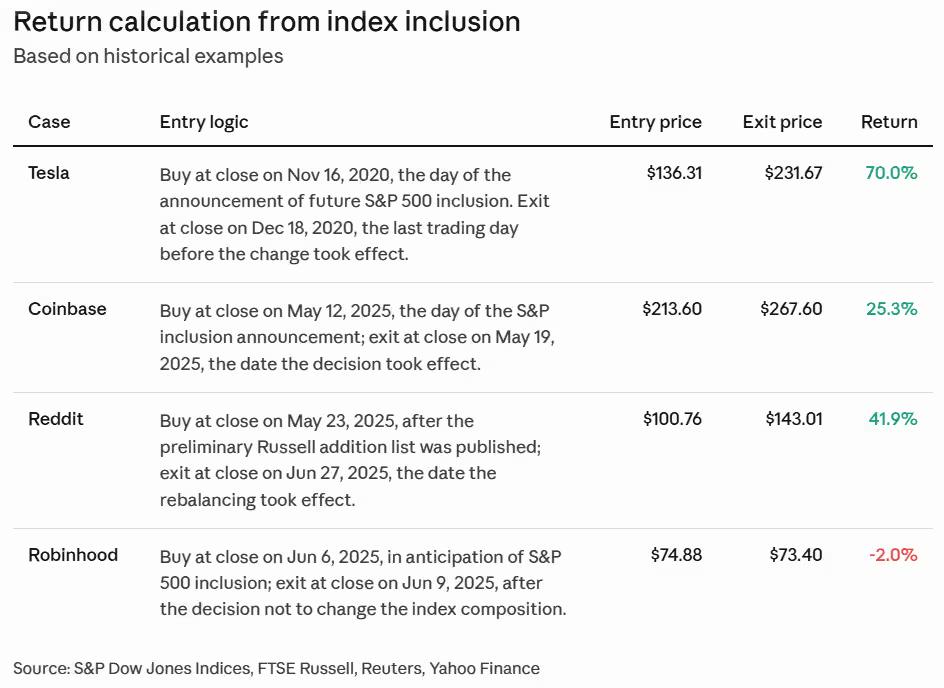
Tesla offers one of the clearest examples of how powerful an index-inclusion catalyst can be. Using the November 16, 2020 closing price of $136.31 as the pre-inclusion reference point, and the December 18, 2020 closing price of $231.67 as the pre-effective-date exit point, the implied return would have been 69.96%.
This case shows that the biggest part of the price move can happen between the formal S&P 500 inclusion announcement and the actual index-fund buying around the rebalance date. In other words, the market often prices in passive fund demand before the company officially enters the index.
Coinbase produced a smaller, but arguably more realistic, index-inclusion example. Using the May 12, 2025 closing price of $213.60, when S&P announced Coinbase’s addition to the S&P 500, and the May 19, 2025 closing price of $267.60, when the change became effective, the implied return would have been 25.28%.
This case is useful because Coinbase was already a liquid, well-followed public company with several years of trading history. For investors analyzing future mega-IPOs such as SpaceX, OpenAI, or Anthropic, Coinbase may offer a more practical benchmark than Tesla’s exceptional 2020 move.
Reddit’s inclusion in the Russell indexes followed a different structure. Unlike S&P 500 additions, which depend on committee decisions, Russell reconstitution is driven by a rules-based annual calendar. Using Reddit’s May 23, 2025 closing price of $100.76, after the preliminary Russell additions list was posted, and its June 27, 2025 closing price of $143.01, when the Russell reconstitution took effect, the implied return would have been 41.93%.
The key lesson is that Russell’s transparent rebalance schedule can give investors more time to position ahead of index-fund demand. But that same transparency also means the stock can rally well before the actual rebalance date.
The article walks through three historical index-inclusion events one at a time. Lined up side by side, the mechanics behind each — which index, what triggered the move, and how much time separated the announcement from the effective date — show why Coinbase's more moderate case, not Tesla's outlier move, is the more realistic reference point for evaluating a future mega-IPO. Investors researching how a stock's price behaved around a specific historical date can look up the underlying data with a stock tracker.
| Company | Index & Inclusion Process | Reference Date & Price | Effective Date & Price | Reference-Period Change | Structural Note |
|---|---|---|---|---|---|
| Tesla | S&P 500 — committee-based decision | Nov 16, 2020 close: $136.31 | Dec 18, 2020 close: $231.67 | 69.96% | Article notes most of the move happened between the announcement and the actual rebalance-date buying, before funds ever purchased a share |
| Coinbase | S&P 500 — committee-based decision | May 12, 2025 close: $213.60 | May 19, 2025 close: $267.60 | 25.28% | Already a liquid, multi-year-traded company at the time of inclusion — article flags this as a more practical benchmark than Tesla's move |
| Russell 3000 — rules-based annual reconstitution | May 23, 2025 close: $100.76 | Jun 27, 2025 close: $143.01 | 41.93% | Reconstitution follows a published annual calendar rather than a committee vote — more lead time, but article notes that same transparency lets the stock rally well before the actual rebalance date |
Figures are the historical closing-price reference calculations discussed above, not guaranteed or predictive trading results; each case reflects a specific completed event with its own index rules, trading history, and float structure. Source: index-provider inclusion records and closing prices as cited in this article.
A strong index-inclusion trade usually requires three elements: a formal event trigger, a clear date when passive funds need to buy, and limited share supply that is not yet fully reflected in the stock price.
When one of these elements is missing, the strategy becomes much more speculative. Instead of a calculated index-inclusion trade, investors may simply be betting that other market participants will continue chasing the same catalyst.
A small public float can cause exaggerated price swings as passive fund inflows combine with early investor selling pressure.
Enhanced index methodology transparency means anticipated buying is frequently priced in advance, narrowing arbitrage windows. Harvard Business School research shows the index inclusion price bump has diminished since the 2000s.
Assets tracking an index don't always lead to immediate share purchases on inclusion, as funds may stagger buying, use derivatives, or employ crossing strategies.
Even meeting formal criteria doesn't guarantee inclusion. Robinhood’s expected S&P 500 addition was vetoed in 2025, causing a 6% share drop.
While passive ownership rises post-inclusion, the long-term upward price impact has decreased alongside market maturity, as documented by the National Bureau of Economic Research.
Profiting from index inclusion events demands more than enthusiasm for headline IPOs. Success requires rigorous analysis of eligibility rules, free float, announcement timing, and unpriced demand potential. Investors equipped to decode index methodologies and market dynamics can still capitalize, though opportunities are becoming less frequent and require a measured, research-driven approach rather than speculation.
For those looking to systematically capture such opportunities with expert analysis and data-driven strategies, 8FIGURES offers valuable insights and tools to navigate this complex market landscape.
Managing your investments has never been easier!