
Try it now!
Managing your investments has never been easier!







Optical interconnects relieve the AI data movement bottleneck that limits cluster scaling once copper traces hit physical constraints. Clusters with hundreds of thousands of accelerators generate mostly chip-to-chip traffic, and any shortfall in network speed leaves processors idle. Electrical signals over copper encounter rapid attenuation, heat buildup, and signal integrity loss beyond the shortest distances. Optical solutions using light in fiber overcome these limits at rack scale and longer reaches while cutting power per bit. Co-packaged optics place photonic elements directly with processors to shrink latency and energy use further. Copper still serves ultra-short intra-rack links where cost favors it, yet physics drives the broader transition to optics at higher speeds. In million-chip clusters most traffic stays chip-to-chip, so idle GPUs represent direct capital waste while network failures every few minutes can erase hundreds of millions in training value. Switches alone draw roughly fifteen percent of total datacenter power, turning any efficiency gain into immediate operating leverage.
The short answer: Optical interconnects replace copper at longer reaches because copper suffers attenuation and heat that optics avoid, with indium phosphide enabling the lasers and detectors required for the shift.
Copper traces lose signal strength quickly as distance or frequency rises. In large AI clusters this forces repeaters and higher power draw that reduce overall efficiency. Designers therefore cap copper use to the shortest board-level or package-level connections where its low cost still prevails. At rack-to-rack distances copper cannot sustain the required lane rates without unacceptable loss, pushing the industry toward fiber once reach exceeds intra-package or intra-board spans. The nuance remains that copper retains an edge at the shortest reaches where its economics still win, yet any move to higher per-lane speeds tilts the physics decisively toward optics.
Higher signaling rates generate excess heat inside dense racks. Optical channels avoid resistive heating and maintain cleaner waveforms over meters of fiber. This physical advantage grows decisive as per-lane speeds move past 100 gigabits. Million-chip clusters experience hardware events every three minutes on average, and even five percent lost utilization on a ten-billion-dollar training run equals roughly five hundred million dollars in wasted capital. Optical links reduce both the heat load and the retransmission overhead that copper incurs at scale.
Light transmission through fiber cuts energy per bit compared with electrical equivalents at rack-to-rack distances. Co-packaged optics integrate lasers and modulators inside the same package as the processor, trimming both power and latency. These improvements allow clusters to scale without proportional rises in cooling demand. Optical switches cut network energy consumption by forty to eighty percent, while co-packaged optics can reduce power per link by up to ninety percent. The resulting drop in overall facility power draw directly improves the economics of operating million-chip systems that would otherwise be throttled by thermal and electrical limits.
Cloud operators adopt optical switching to manage growing east-west traffic. Component suppliers see rising demand for higher-speed transceivers and wavelength-management subsystems that support 200-gigabit lanes and beyond. The optics market for datacenters is projected to expand from roughly eighteen billion dollars to more than ninety billion dollars, illustrating a compound annual growth rate near forty percent. This trajectory reflects the structural need for faster, lower-power interconnects as model training costs climb from hundreds of millions to multiple billions per frontier system.
Silicon cannot generate or detect light efficiently at the wavelengths and speeds needed for data-center optics. Indium phosphide fills this gap as the compound semiconductor of choice for laser sources and photodetectors. The resulting supply-chain concentration rewards upstream exposure to indium-phosphide production capacity. Indium phosphide already accounts for seventy-nine percent of high-speed optical channels and is expected to reach ninety-one percent by the end of the decade, up from forty-four percent earlier in the cycle. This rising share cements the material as the essential enabler for the lasers and detectors that copper cannot replace.
Metal-organic chemical-vapor deposition tools deposit the precise epitaxial layers required for indium-phosphide devices. Suppliers of these tools and related process equipment therefore sit at the center of capacity expansions. Without sufficient deposition capacity the entire optical supply chain cannot scale to meet the bandwidth demands of clusters that must exchange data continuously across hundreds of thousands of accelerators.
Investors gain indirect participation in AI infrastructure growth by owning component and equipment makers rather than betting directly on frontier model developers. Demand for optical links tracks accelerator deployments yet avoids single-customer concentration. Big-tech capital spending on AI infrastructure can reach levels comparable to the GDP of mid-sized economies, with the largest share flowing to hyperscalers and chipmakers, yet the optical layer becomes the binding constraint once copper physics intervenes.
Multiples already price sustained growth. Position sizing must reflect tolerance for order volatility and margin variability across the cycle. All three companies trade at elevated multiples that embed expectations of continued AI-driven demand, making disciplined sizing essential for investors who accept cyclical swings in bookings and gross margins.
| Company | Core Exposure | Margin Profile |
|---|---|---|
| Lumentum | Laser chips and transceivers | Operating margin above 20 percent |
| Oxford Instruments | Compound-semiconductor process tools | High single-digit organic growth |
| Aixtron | MOCVD deposition equipment | Gross margin near 40 percent |
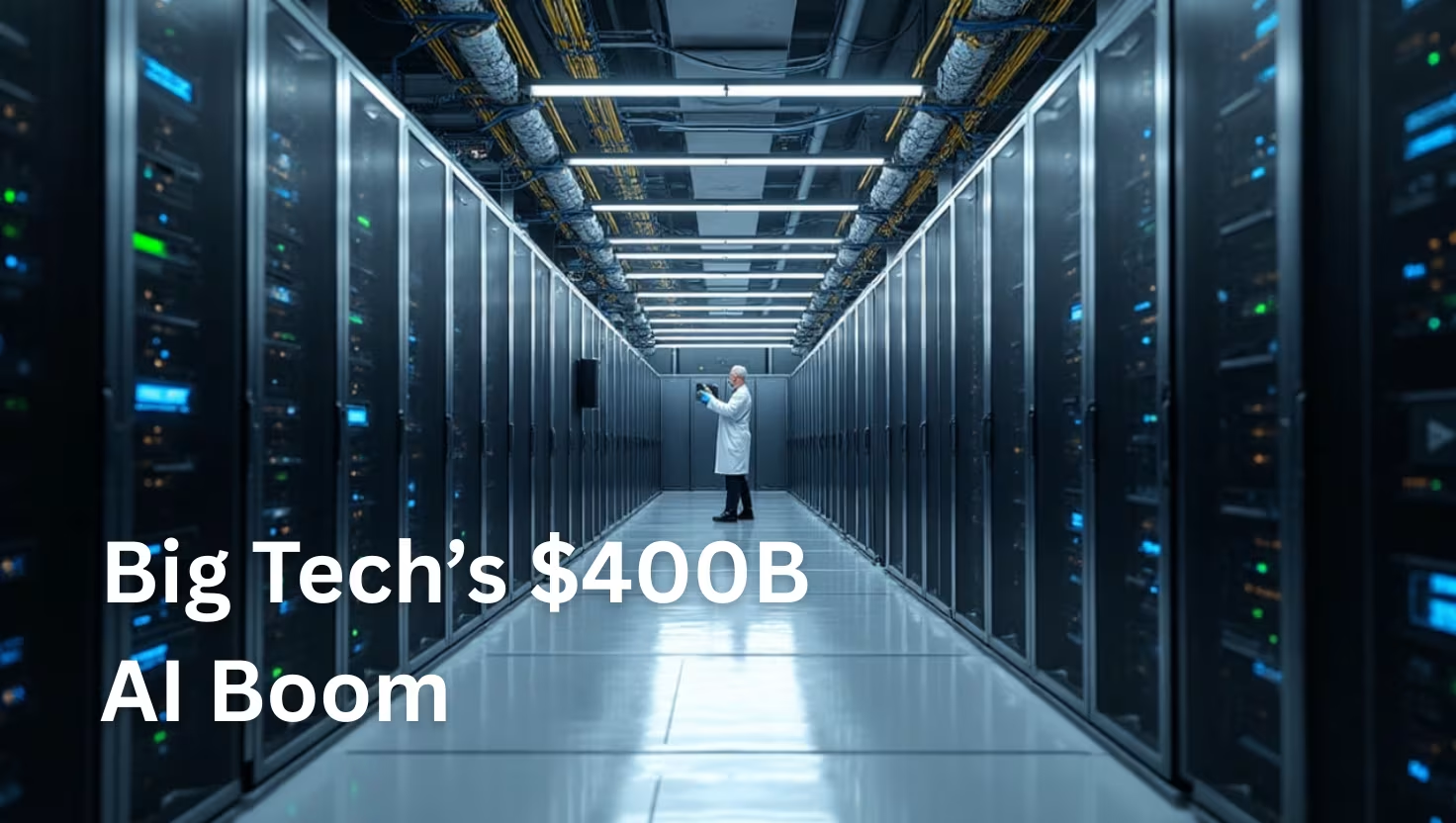
Lumentum produces the laser chips, wavelength-management subsystems, and finished transceivers that link AI accelerators. Components drive the majority of recent revenue growth as customers adopt faster channels. Optical switching products form an emerging revenue stream with multi-billion-dollar long-term potential. Gross margins expanded as mix improved and unit costs declined. Research spending rose while administrative costs fell, preserving operating leverage. International sales represent the bulk of revenue, and inventory builds have increased working-capital needs. Big Tech's $400B AI Cap-Ex Boom details the spending wave that supports these components. The company reports roughly seventy-seven percent of revenue outside the United States, with components contributing the largest incremental dollars through 200-gigabit-per-lane laser chips and assemblies. Cloud transceivers added further growth, while optical switches already exceed twenty-five million dollars in quarterly revenue and address a market that Cignal AI projects above two and a half billion dollars by 2029.
Oxford Instruments supplies precision instrumentation for materials analysis and compound-semiconductor fabrication. Its Imaging and Analysis segment produces most revenue and profit. The Advanced Technologies segment addresses indium-phosphide and cryogenic needs relevant to optical manufacturing. Organic growth reached mid-single digits with North America leading. Free cash flow supports dividends and modest repurchases. Portfolio streamlining improved focus on higher-margin markets. The company is divesting its NanoScience quantum unit, which reduces exposure to China and sharpens emphasis on imaging, analysis, and semiconductor process tools. Regional revenue shows North America at roughly thirty-one percent, EMEA and India at twenty-seven percent, with China trimmed to twenty-one percent. Annual revenue reached five hundred million pounds with organic growth of six point four percent, and the firm returned capital via a twenty-two point two pence dividend plus approximately fifty million pounds in buybacks.
Aixtron builds metal-organic chemical-vapor-deposition systems used for indium phosphide, gallium nitride, and silicon carbide wafers. These tools enable both optical interconnect devices and efficient power delivery inside AI facilities. Order backlog stayed substantial even as quarterly bookings moderated from peak levels. Gross margins held near 40 percent. Longer-term capacity additions for optics and power electronics underpin expected recovery. $1 Trillion Semiconductor Revenue Hides Concentration Risk highlights similar supply-chain dynamics. The G10 tool platform supports 150-millimeter, 200-millimeter, and future 300-millimeter wafers for silicon carbide, gallium nitride, and optoelectronics. Near-term silicon carbide oversupply tempers orders, yet gallium nitride and indium phosphide demand tied to AI power delivery and optical links supports a rebound once excess capacity clears. Operating cash flow reached two hundred eight million euros and free cash flow one hundred eighty-two million euros in the most recent period, demonstrating strong conversion even as revenue moderated.
Structural demand for optical interconnects persists because cluster scale collides with copper physics. Suppliers of indium-phosphide materials, deposition equipment, and photonic components hold durable positions in the value chain when valuations match execution risks. Analyze your portfolio concentration with 8FIGURES to identify exposure to these supply chain opportunities.
Managing your investments has never been easier!