
Try it now!
Managing your investments has never been easier!





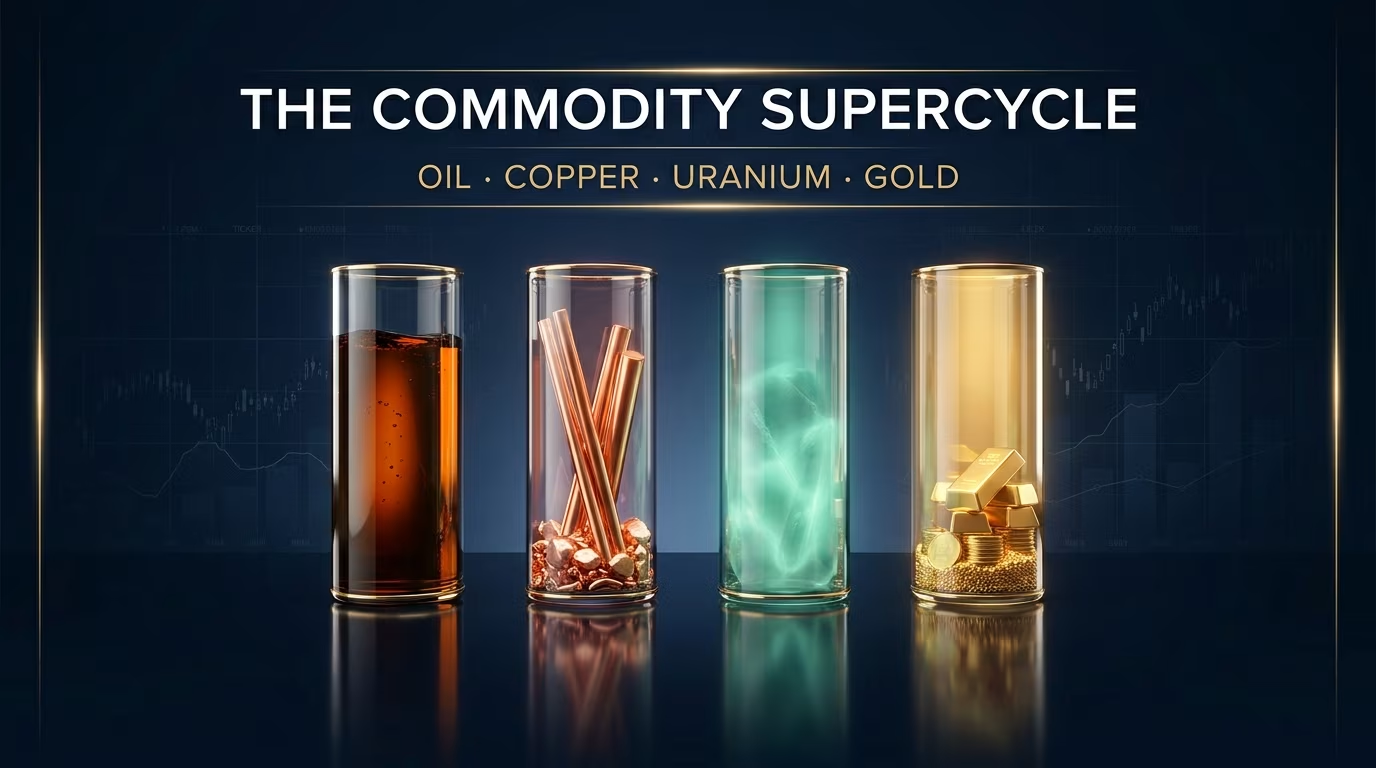

A commodity supercycle is one of the most powerful forces in investing, and also one of the most misunderstood. For years the biggest investment banks predicted that surging demand for metals and energy would lift raw-material prices for a decade or more. The cycle eventually arrived, but not for the reasons most forecasts assumed. Instead of a smooth transition to electric vehicles and green infrastructure, the catalyst was a collision of geopolitical shock and structural shortages in mining and drilling. For investors, the lesson is durable: commodity cycles reward those who understand the difference between a temporary price spike and a lasting supply imbalance.
The short answer: A commodity supercycle is a prolonged period, often a decade or longer, in which raw-material prices stay elevated because demand structurally outpaces supply. It differs from a normal price rally because the imbalance is rooted in long-lived forces such as underinvestment in mines, multi-year development timelines, and secular shifts in demand, rather than a passing disruption that resolves in a quarter or two.
Raw-material prices move on the gap between how fast the world wants a resource and how fast producers can deliver it. Supply is slow to respond. A new copper mine can take 15 to 17 years from discovery to first production, and a nuclear reactor takes the better part of a decade to build. When a demand surge meets that kind of lag, prices do not drift higher, they jump. The defining feature of a supercycle is that the supply side cannot catch up quickly even when prices scream for more output.
Two forces tend to stack on top of each other. The first is structural: electrification, grid expansion, and the energy appetite of computing all pull harder on copper, uranium, and oil over time. The second is acute: a war, an embargo, or a chokepoint disruption can strip millions of barrels or tonnes from the market in weeks. When a short-term shock lands on top of a long-term deficit, the price reaction is amplified. That stacking is exactly what turned years of forecasts into reality across oil, copper, uranium, and gold.
For investors, the practical question is rarely "is the commodity going up." It is "which instrument matches my view and my time horizon." A futures-based fund behaves very differently from a basket of producer equities, and a physical-metal trust behaves differently again. The rest of this guide walks through the four commodities at the center of the cycle and the ETF toolkit that maps to each one.
Oil is the commodity where geopolitics shows up fastest in the price. When conflict in the Middle East threatens a shipping chokepoint like the Strait of Hormuz, the market prices in a risk premium almost immediately. During one such crisis, Brent crude swung into a $90 to $100 range after climbing more than 50% from the start of the year, even though a formal ceasefire was technically in place. Maritime traffic ran at a fraction of normal levels because mined waterways, the threat of renewed attacks, and the absence of insurance coverage kept tankers away. Lost supply across the market reached double-digit millions of barrels per day, strategic reserves drained, and even record exports from the United States could not fully close the gap.
Geopolitical oil shocks usually resolve along one of two paths, and the distinction matters for positioning. In the first, the chokepoint reopens and the disruption is contained to a single quarter. The Federal Reserve Bank of Dallas has modeled a hit of roughly 0.2 percentage points to global GDP growth in that mild case, an outcome markets can absorb as long as corporate profits hold up. Oil then tends to fade back toward $70 to $80 as the risk premium bleeds out. Even so, tanker owners do not rush back into a mined zone, so clearing mines, arranging insurance, and restoring regular traffic can take weeks.
In the second path, the conflict drags on for three quarters or more. The same Dallas Fed model puts the damage to global growth near 1.3 percentage points, with oil holding above $90. Natural gas adds another wrinkle. Roughly a fifth of the world's liquefied natural gas passes through the same strait, so a blockage lengthens shipping routes and lifts freight rates, while a domestic benchmark like Henry Hub is touched only indirectly through export terminals.
Energy investors can choose between betting on the price of the barrel itself or on the companies that produce it. The two behave differently across time horizons.
| Fund | Exposure | Best for |
|---|---|---|
| USO / BNO | Oil futures (WTI / Brent) | Short-term price bets. BNO tracks Brent, the better benchmark for seaborne-supply shocks. Both lose value to roll costs in contango. |
| XLE | Largest oil producers | The cheapest broad way to own oil majors, with an expense ratio near 0.08%. |
| OIH | Oilfield services (SLB, Baker Hughes, Halliburton) | Leverage to rising drilling activity and capital spending. |
| UNG | U.S. natural gas futures | Domestic gas exposure. Does not track global LNG prices directly. |
Over a horizon of several months, producer equities generally hold up better than futures funds, because the roll cost of replacing an expiring contract with a more expensive one steadily erodes a futures fund's return. For a focused view on energy security as a long-run theme, the same logic shows up in Europe's energy pivot.
Copper is the metal that turns the electrification story into a balance-sheet reality. Prices have a long history of climbing when the world tries to wire more of itself at once. In one stretch, copper rose from around $11,000 to nearly $14,500 per tonne as several forces fired together: a physical shortage of ore, rising consumption from electrified transport and AI infrastructure, and a wave of speculative interest amplified by the spending plans of large technology firms.
The supply side of copper is constrained in ways that do not fix quickly. Ore grades at existing mines keep falling, so producers must dig and process more rock to deliver the same metal. Average grades in Chile, the world's largest source, have dropped roughly 40% since 1990. New discoveries are scarce, with only about 5% of major deposits found in the last decade, and permitting plus construction can run 15 to 17 years. S&P Global has projected world copper demand climbing from roughly 28 million tonnes toward more than 42 million tonnes by 2040, while mine output is expected to peak near 33 million tonnes around 2030 and then decline.
One signal captures how tight the market can get. Treatment and refining charges, the fees smelters earn for turning concentrate into finished metal, have collapsed toward zero and even gone negative in spot markets. When that happens, smelters are effectively paying miners for the privilege of access to ore, a clear sign that raw material, not processing capacity, is the binding constraint. It is the kind of dislocation that does not appear in a normal market and tends to accompany genuine deficits.
| Fund | Exposure | Best for |
|---|---|---|
| CPER | Copper futures | The most direct liquid exposure to the metal. Spreads across three contract maturities to soften roll costs. |
| COPX | Copper miners (broad) | The largest miner fund, evenly weighted with no single dominant holding. |
| ICOP | Diversified miners | Lower fee near 0.47% and broader reach into diversified miners like BHP and Anglo American. |
| COPP | Concentrated miners | A concentrated bet, with around a quarter in Freeport-McMoRan. |
| COPJ | Junior explorers | The most volatile choice, sensitive to both copper prices and small-company financing. |
Forecasts for copper diverge sharply, which itself is useful information. Some analysts expect a near-term oil shock to cool industrial demand and keep the market in modest surplus, while longer-run projections point to sustained deficits from grids, AI infrastructure, and defense spending. The disagreement is mostly about timing, not direction, and that is the hallmark of a structural theme.
The cleanest way to understand uranium's renewed appeal is to follow the electricity. Data centers run around the clock, and neither solar nor wind can guarantee steady output on its own. Nuclear power offers a rare combination of constant supply, large scale, and zero carbon emissions, which is why large technology companies have begun contracting reactor capacity directly. In one tally, the biggest firms lined up more than 9.7 gigawatts of nuclear capacity across more than a dozen deals, equivalent to roughly twelve large reactors. Commitments ranged from restarting a mothballed reactor to ordering small modular units and signing multi-gigawatt agreements stretching to 2035.
Uranium prices reflect two different markets. The spot price can spike and retreat on sentiment, while the long-term contract price, the rate utilities lock in for guaranteed delivery, tells you more about real intentions. That contract price reaching multi-year highs signals that buyers are willing to pay up for security of supply. The catch is timing. Real growth in uranium consumption arrives only as new reactors come online later in the decade, so expectations move faster than physical demand. That gap is why uranium prices can be so volatile even when the long-run direction looks clear, a pattern that mirrors the broader AI infrastructure spending boom.
| Fund | Exposure | Best for |
|---|---|---|
| URNM | Uranium miners + physical | The most direct read on uranium prices, with a slice held in physical uranium. Reacts fastest to spot moves. |
| URA | Broader nuclear fuel cycle | Wider reach including reactor developers, capturing the "new nuclear" theme. |
| NLR | Nuclear utilities | Lowest fee near 0.52%, weighted to power companies whose earnings track electricity, not uranium. |
| NUKZ | Reactor technology | Thematic exposure to reactor builders and small modular reactor developers. |
| GRID | Grid equipment | No uranium holdings. Pure exposure to grid hardware makers like ABB, Eaton, and Schneider Electric. |
Gold carries a reputation as the classic inflation hedge, and that reputation is only half right. Investors often expect gold to rise whenever consumer prices climb, then feel blindsided when it falls during a genuine inflation scare. The resolution is one of the most useful ideas in macro investing: gold does not respond to the headline inflation rate. It responds to real interest rates, the gap between bond yields and expected inflation.
The mechanism is a chain reaction. An oil shock pushes inflation higher, the market starts pricing tighter central-bank policy, the currency strengthens, bond yields rise, and suddenly holding an asset that pays no interest becomes more expensive. That is why gold can sell off even as inflation accelerates. Real rates, not the CPI print, are the single most reliable short-term driver of the gold price. Understanding that one relationship explains most of gold's apparent contradictions.
There is a second, slower force underneath. Central banks have been buying gold at well above 800 tonnes per year, nearly double the prior decade's pace, building a structural demand floor even when Western investors were selling. In that sense, gold increasingly functions less as protection against inflation and more as insurance against systemic risk: rising government debt, currency devaluation, and erosion of trust in institutions. For miners, an oil shock cuts both ways, since higher diesel and power costs raise the cost of pulling metal out of the ground.
| Fund | Exposure | Best for |
|---|---|---|
| GLD | Physical gold | The most liquid and popular way to own gold exposure. |
| IAUM | Physical gold (low cost) | Long-term holders. A fee near 0.09% versus 0.40% saves roughly $1,550 per $100,000 over five years. |
| GDX | Gold miners | Leverage to the gold price through producer margins, which expand as gold rises. |
| GDXJ | Junior gold miners | Higher-octane miner exposure, with more volatility and more sensitivity to costs. |
The instrument you pick should follow your time horizon and your conviction, not the headline. A practical way to decide:
If you are weighing how a tilt toward energy, metals, or gold would change your overall risk profile, the 8FIGURES AI Investment Advisor can analyze your current holdings and model how a specific commodity allocation, say a 5% position in copper miners, would shift your concentration and diversification across the whole portfolio.
The commodity supercycle that forecasters described did at least partly arrive, just not through the clean energy-transition story everyone expected. The real catalysts were a geopolitical shock layered on top of structural deficits in production. For every segment of the market there is now a developed lineup of exchange-traded funds, and the right choice comes down to your horizon and your read on each specific commodity, from short-term futures positioning to long-term ownership through producer equities or physical metal. The investors who do best in a supercycle are the ones who match the instrument to the thesis, rather than chasing the price.
Managing your investments has never been easier!